No. 04 · Dutch East Indiaman
Batavia
Lost 4 June 1629 · Indian Ocean · 4–7 m
A Dutch East Indiaman wrecked on an Australian reef in 1629, whose survivors suffered one of the darkest mutinies in maritime history.
- Flag
- Dutch Republic (VOC)
- Built
- VOC yard, Amsterdam, 1628
- Length
- about 45 m
- Aboard
- about 322–341
- Lives lost
- about 40 drowned; at least 110 later murdered on the islands
- Survived
- about 122 reached Batavia
- Position
- 28°29.4′ S, 113°47.4′ E
- Lies at
- 4–7 m, coral
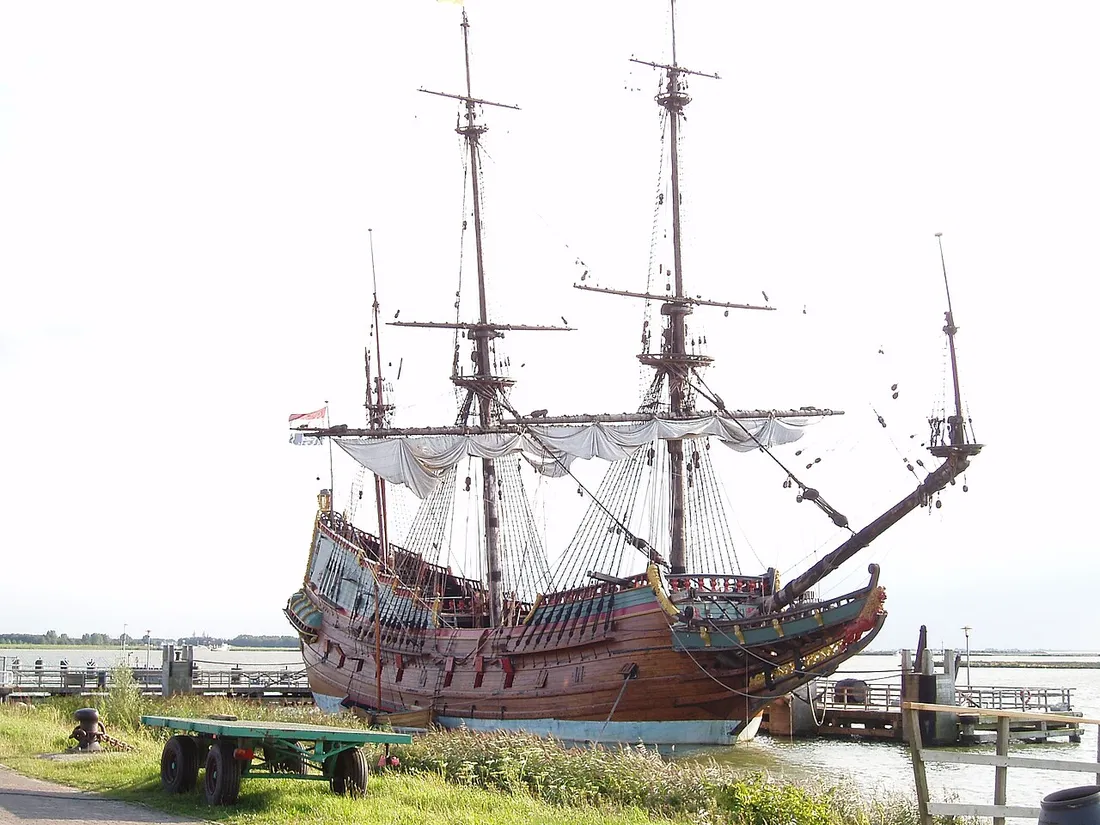
Batavia was on her first voyage to the Dutch East Indies, carrying silver, passengers and a gateway of cut sandstone for the company's castle in Java. She ran onto a reef in the dark, far closer to land than her officers believed.
Cause. Sailing in the dark and believing they were far from land, the officers ran her onto a coral reef.
Plate · elevation, starboard side
The ship
Load waterline
Elevation, starboard side
The last hours
Ship and depth drawn to the same scale.
-
29 October 1628
Out from Texel
Batavia left for the Indies with the company's commander Francisco Pelsaert, skipper Ariaen Jacobsz, passengers including women and children, and chests of silver.
-
4 June 1629, before dawn
On the reef
About two hours before daybreak she ran hard onto Morning Reef. About 40 people drowned; most of the rest reached small, waterless coral islands nearby.
-
Early June
The longboat leaves
Finding no water, Pelsaert, Jacobsz and more than forty others took the longboat, searched the mainland coast in vain and sailed on to Java, arriving about a month later.
-
June–September
The mutiny
Under-merchant Jeronimus Cornelisz took control of the survivors, and his followers killed at least 110 men, women and children. Soldiers led by Wiebbe Hayes held out on West Wallabi Island.
-
17 September 1629
Rescue
Pelsaert returned aboard the Sardam. Hayes reached him first and warned him, and the mutineers were captured and later tried.
- Port side of the stern, under sand
- Stone blocks of a gateway
- Cannon
- Anchors
Elevation, starboard side, as found.Co coral · 4–7 m
As found
Where she lies
She lay in a shallow hollow on the reef top in a few metres of water, with cannon, anchors and blocks of the stone gateway in view, and part of the port side of her stern preserved under sand. The Western Australian Museum excavated the site in 1972–76 and raised the surviving timbers.
Found
Found in 1963 on Morning Reef by a crayfisherman and divers from Geraldton, following Henrietta Drake-Brockman's research that placed the wreck in the Wallabi Group.
Today
A protected historic shipwreck. The reassembled stern and the stone portico are in the WA Shipwreck Galleries, Fremantle. A full-size replica sails from Lelystad in the Netherlands.