No. 05 · Bomb vessel fitted for the Arctic
HMS Erebus
Lost Abandoned 22 April 1848; sinking date unknown · Queen Maud Gulf, Arctic Canada · about 11 m
Franklin's flagship, abandoned in the Arctic ice in 1848 with the loss of every man of the expedition, was found in 2014 thanks largely to Inuit memory.
- Flag
- Royal Navy
- Built
- Pembroke Dockyard, 1826
- Length
- about 32 m
- Aboard
- 129 men on Erebus and Terror together
- Lives lost
- all 129
- Survived
- none
- Position
- 68°13.8′ N, 98°42.0′ W
- Lies at
- about 11 m, sand and silt
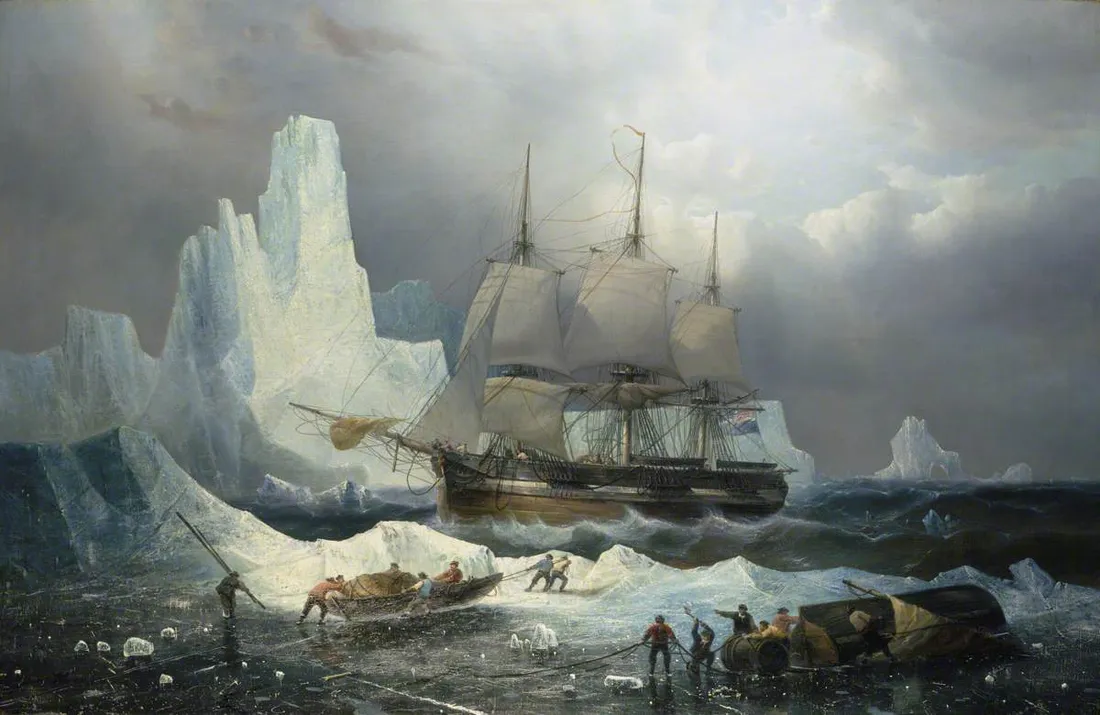
Erebus and Terror sailed in 1845 to complete the Northwest Passage, with Sir John Franklin in command. Neither ship came home, and no man of the 129 survived. For 166 years the only clues were a few notes, graves, relics, and what Inuit had seen and remembered.
Cause. Held fast in the sea ice for two winters, the ships were abandoned. How and when Erebus sank is unknown.
Plate · elevation, starboard side
The ship
Load waterline
Elevation, starboard side
The last hours
Ship and depth drawn to the same scale.
-
19 May 1845
Out from Greenhithe
Franklin sailed with Erebus and Terror to find the last link of the Northwest Passage. Whalers last saw the ships in Baffin Bay in late July.
-
12 September 1846
Beset
Both ships were caught in the ice of Victoria Strait, north-west of King William Island, and never sailed free again.
-
11 June 1847
Franklin dies
Sir John Franklin died aboard with the ships still trapped. The cause is not recorded.
-
22 April 1848
The ships abandoned
After a second winter in the ice, the 105 surviving men under Captain Francis Crozier left the ships to walk south. None of them reached safety.
-
After 1848
Far to the south
Inuit accounts describe a ship near the Adelaide Peninsula with signs of people aboard. Erebus sank there, in shallow water, at a date no one knows.
- Deck torn away by ice
- Mainmast, sheared off
- Kelp
- Iron-sheathed bow
Elevation, starboard side, as found.S sand and silt · about 11 m
As found
Where she lies
She sat nearly upright and remarkably intact in about 11 m of water, her stern damaged and her upper deck partly torn away by ice. Storms and ice have since broken up more of the deck, so Parks Canada and Inuit guardians are recovering objects while they can.
Found
Found on 2 September 2014 by Parks Canada's Victoria Strait Expedition, searching where Inuit oral history pointed, notably the testimony gathered by historian Louie Kamookak.
Today
Part of the Wrecks of HMS Erebus and HMS Terror National Historic Site, managed jointly by Parks Canada and Inuit. The exact position is withheld; the mark on this chart is approximate.