No. 02 · Tudor carrack, warship of Henry VIII
Mary Rose
Lost 19 July 1545 · The Solent, English Channel · 11–14 m
Henry VIII's warship sank in sight of her king in 1545, taking most of her crew with her, and was raised in 1982 with the remains of Tudor life still inside.
- Flag
- Kingdom of England
- Built
- Portsmouth, 1510–1511; rebuilt c. 1536
- Length
- about 45 m overall; keel about 32 m
- Aboard
- about 400–500
- Lives lost
- about 365–500
- Survived
- fewer than 35
- Position
- 50°45.8′ N, 1°06.2′ W
- Lies at
- 11–14 m, mud and silt
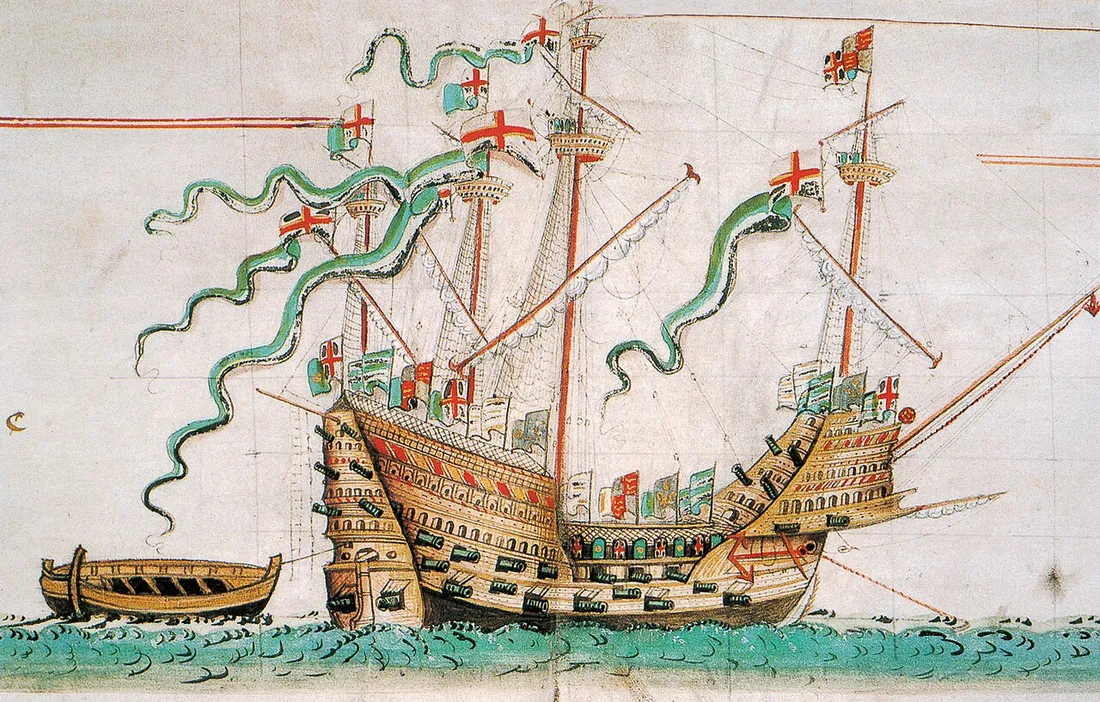
For more than thirty years the Mary Rose was one of the great ships of Henry VIII's navy. She sank in minutes while turning to fight a French invasion fleet, close enough to shore for the king to watch. The Solent silt kept half of her for 437 years.
Cause. She heeled over while turning and water poured in through her open lower gun ports. Why she heeled (a gust, overloading, confusion aboard or French gunfire) is still debated.
Plate · elevation, starboard side
The ship
Load waterline
Elevation, starboard side
The last hours
Ship and depth drawn to the same scale.
-
18 July 1545
The French arrive
A large French fleet under Admiral Claude d'Annebault entered the Solent to land troops and draw out the English ships lying at Portsmouth.
-
19 July, morning
Galleys in the calm
With almost no wind, French galleys rowed forward and fired on the English ships, which could not manoeuvre. Henry VIII watched from the shore near Southsea Castle.
-
19 July, afternoon
A breeze, and the fleet sails
When the wind rose, the English fleet came out. Sir George Carew, newly made vice-admiral, commanded aboard the Mary Rose.
-
Late afternoon
The heel
Turning, apparently to bring her other broadside to bear, she heeled sharply to starboard. Water rushed in through the open lower gun ports.
-
Minutes later
Under the netting
She went down within minutes. Netting rigged over the open decks to stop boarders trapped most of the men; fewer than 35 are thought to have survived. Carew was among those lost.
- Frames of the starboard side, laid bare
- Planking kept by the silt
- Lower sterncastle
Elevation, starboard side, as found.M mud and silt · 11–14 m
As found
Where she lies
She lay heeled about 60 degrees to starboard in soft silt. The buried starboard half survived, while the exposed port side had been worn away. Tens of thousands of objects were recovered, from longbows to the crew's combs. The hull was lifted on 11 October 1982 in a steel cradle.
Found
Located by Alexander McKee's amateur divers with sonar help from Harold Edgerton in 1966–67, and identified on 5 May 1971 when divers uncovered her timbers.
Today
Raised in 1982 and displayed with her contents in the Mary Rose Museum, Portsmouth Historic Dockyard. The seabed site remains a Protected Wreck managed by Historic England.