No. 01 · Roman-era merchant ship
Antikythera wreck
Lost c. 70–60 BC · Aegean Sea · 45–55 m
An ancient cargo ship that broke up under the cliffs of a small Greek island, carrying bronze and marble statues and the gearwork computer now called the Antikythera mechanism.
- Flag
- Unknown
- Built
- Unknown
- Length
- perhaps 40–50 m (estimated from the wreck site)
- Aboard
- Unknown
- Lives lost
- Unknown
- Survived
- Unknown
- Position
- 35°53.4′ N, 23°18.5′ E
- Lies at
- 45–55 m, rock and boulders
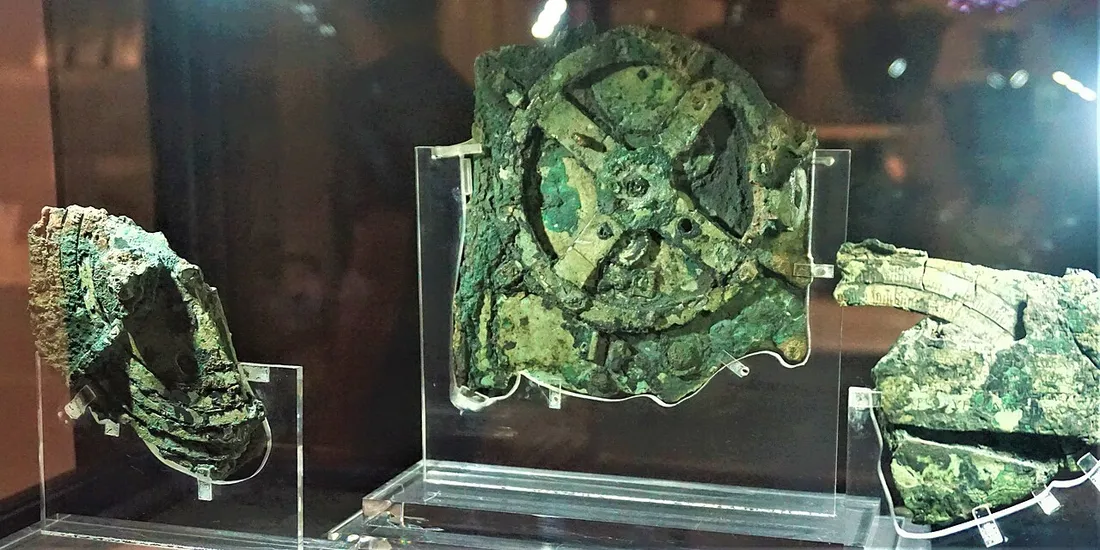
No one wrote down the loss of this ship. Coins and pottery from the wreck place it around 70–60 BC, probably heading west towards Italy with treasures from the eastern Aegean. She was found by accident two thousand years later, and one corroded lump from her cargo turned out to be the most complex machine known from the ancient world.
Cause. Unknown. She probably struck the cliffs of Antikythera, most likely in a storm.
The ship drawn above is a merchantman of the period, not a portrait: nothing of her shape survives.
Plate · elevation, starboard side
The ship
Load waterline
Elevation, starboard side
The last hours
Ship and depth drawn to the same scale.
-
c. 70–60 BC
Loaded in the east
Her cargo of bronze and marble statues, glassware, fine pottery and coins points to ports such as Pergamon and Ephesus. Where she actually loaded is inferred, not recorded.
-
c. 70–60 BC
Under the cliffs
She sank close under the island's north-east cliffs. No account of the wreck survives; the people aboard are known only from bones found on the seabed.
-
Spring 1900
Sponge divers
Divers from Symi under Captain Dimitrios Kontos, sheltering from a storm, went down for sponges. Elias Stadiatis came up from about 45 m saying the seabed was full of statues.
-
1900–1901
The first excavation
With navy support the divers raised statues, among them the bronze Antikythera Youth. Work stopped after one diver died and two were paralysed by decompression sickness.
-
17 May 1902
A gear in the bronze
In the National Archaeological Museum in Athens, Valerios Stais noticed a gear wheel in a corroded lump: the Antikythera mechanism, an ancient astronomical calculator.
- Amphorae spilled down the slope
- A corroded bronze lump, as it might have lain
- Boulders fallen from the cliffs
Elevation, starboard side, as found.R rock and boulders · 45–55 m
As found
Where she lies
No hull stands above the seabed. The cargo lies scattered down a steep rocky slope, and what remains of her timbers is buried under sediment and boulders. Divers and robots of a Greek-led project with Woods Hole have worked the site since 2012, recovering further finds and, in 2016, part of a human skeleton.
Found
Found by chance in spring 1900 by sponge divers from Symi under Captain Dimitrios Kontos.
Today
A protected archaeological site under the Greek Ephorate of Underwater Antiquities. The finds, the mechanism among them, are in the National Archaeological Museum, Athens.