No. 11 · Italian ocean liner
SS Andrea Doria
Lost 26 July 1956 · North Atlantic · about 75 m
Italy's elegant post-war liner sank off Nantucket in 1956 after a collision in fog; a vast rescue saved almost everyone aboard.
- Flag
- Italy (Italian Line)
- Built
- Ansaldo, Genoa, 1950–1953
- Length
- about 213 m
- Aboard
- 1,706
- Lives lost
- 46, and 5 crew of the Stockholm
- Survived
- about 1,660
- Position
- 40°29.4′ N, 69°51.0′ W
- Lies at
- about 75 m, sand and clay
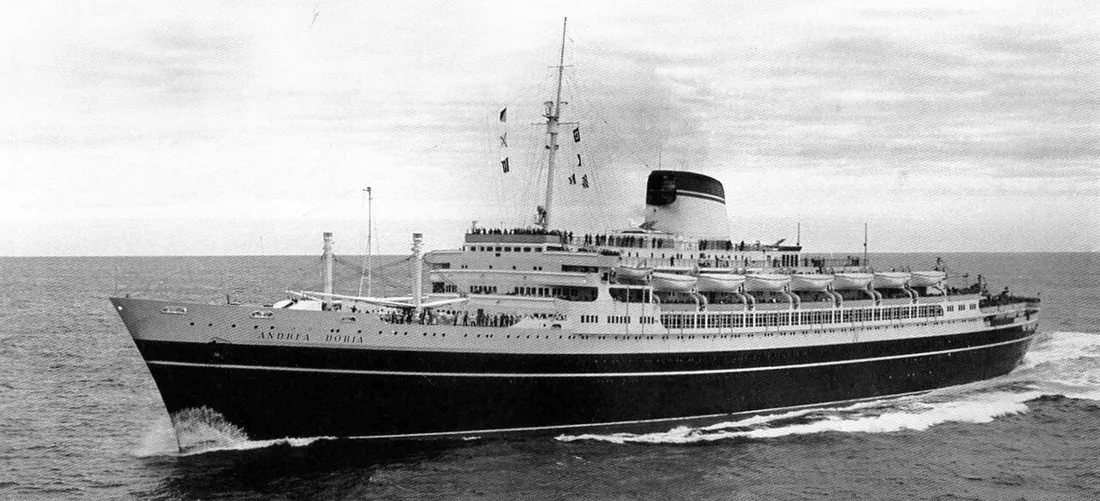
Andrea Doria was the pride of Italy's post-war merchant fleet, on her 51st westbound crossing and one night from New York. She stayed afloat for eleven hours after the collision, long enough for ships to come.
Cause. In fog, she and the Swedish liner Stockholm misread each other's positions on radar and turned towards each other. Stockholm's bow tore into her starboard side.
Plate · elevation, starboard side
The ship
Load waterline
Elevation, starboard side
The last hours
Ship drawn to scale; the water below is not.
-
17 July 1956
Out of Genoa
Andrea Doria began her crossing to New York under Captain Piero Calamai.
-
25 July, evening
Fog off Nantucket
She ran for hours through dense fog at only slightly reduced speed. The eastbound Stockholm was approaching the same fog bank; each saw the other only on radar.
-
About 23:10
The collision
Stockholm's reinforced bow struck her starboard side and cut deep into the hull. She quickly listed more than 20 degrees.
-
Night
Half the boats useless
The list meant the port-side lifeboats could not be launched. Calls for help brought the freighter Cape Ann, the navy transport Private William H. Thomas and other ships.
-
26 July, about 02:00
Île de France
The French liner turned back to help, arrived about three hours after the collision with all her lights blazing, and took aboard the largest number of survivors.
-
About 06:00
Everyone off
By around dawn all the survivors had been taken off. Captain Calamai was among the last to leave.
-
10:09
She rolls over
Eleven hours after the collision she rolled onto her starboard side and sank, watched from aircraft overhead.
At 75 m the pressure is about 9 times what it is at the surface.
- The hull cracking open
- Upper decks, fallen to the seabed
- Bow
Survey plan, seen from above: she lies on her starboard side, so her port side faces the surface.S sand and clay · about 75 m
As found
Where she lies
She came to rest on her starboard side in about 75 m of water. Over the decades the hull has cracked, the upper decks have slid off onto the seabed and the wreck is steadily collapsing. Currents, cold and fishing nets make her one of the most dangerous wreck dives in the world.
Found
Her position was known. Divers Peter Gimbel and Joseph Fox made the first dive on her the day after she sank.
Today
A wreck in international waters without formal protection.