No. 12 · Great Lakes ore freighter
SS Edmund Fitzgerald
Lost 10 November 1975 · Lake Superior · about 160 m
The largest freighter on the Great Lakes when she was built, the Edmund Fitzgerald vanished in a Lake Superior storm in 1975 with all 29 crew.
- Flag
- United States
- Built
- Great Lakes Engineering Works, Michigan, 1957–1958
- Length
- about 222 m
- Aboard
- 29
- Lives lost
- 29
- Survived
- none
- Position
- 46°59.9′ N, 85°06.6′ W
- Lies at
- about 160 m, clay and mud
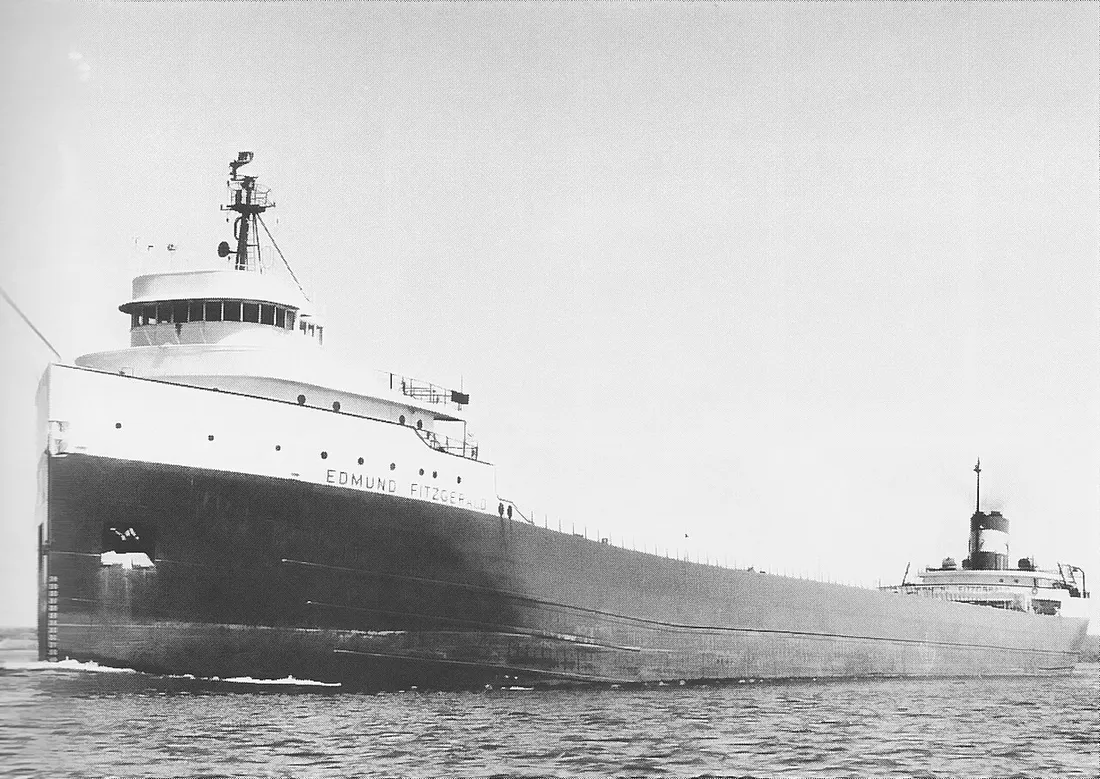
For seventeen years the 'Fitz' carried iron ore down the lakes. On her last trip she ran into one of the worst November storms on record, with another freighter close behind her the whole way.
Cause. She foundered in a severe storm after taking on water. The exact cause (hatch covers, shoal damage, huge waves or a structural failure) has never been settled.
Plate · elevation, starboard side
The ship
Load waterline
Elevation, starboard side
The last hours
Ship drawn to scale; the water below is not.
-
9 November 1975, 14:15
Out of Superior
She left Superior, Wisconsin, under Captain Ernest McSorley with about 26,000 tons of taconite ore pellets, bound for the Detroit area. A storm was forecast.
-
10 November, morning
Into the storm
She and the freighter Arthur M. Anderson took a northerly route along the Canadian shore. Winds reached near hurricane force, with waves of up to about 10 m.
-
About 15:30
Damage reported
McSorley radioed the Anderson that a fence rail was down, two vents were lost and the ship had a list, and asked the Anderson to stay close.
-
About 16:10
Radar out
Both of her radars failed. The Anderson began guiding her by radio towards the shelter of Whitefish Bay.
-
About 19:10
Holding their own
Asked how they were doing, McSorley replied that they were holding their own. It was the last message from the ship.
-
About 19:15
Gone from the radar
The Fitzgerald vanished from the Anderson's radar without a distress call. The Anderson and others turned back to search, and found only boats and debris.
At 160 m the pressure is about 17 times what it is at the surface.
- Pilothouse
- Bow section, upright
- Hull broken up, ore pellets scattered
- Stern section, upside down
Elevation, starboard side, as found.M clay and mud · about 160 m
As found
Where she lies
She lies in two main pieces: the bow upright in the mud, the stern upside down about 50 m away, with the middle of the hull broken up between them and ore pellets scattered across the site. In 1995 her bell was raised and replaced with a replica engraved with the names of the 29 crew.
Found
Located on 14 November 1975 by a US Navy aircraft with a magnetic anomaly detector, and confirmed in 1976 with the navy's remote-controlled vehicle CURV-III.
Today
A gravesite in Canadian waters, protected under the Ontario Heritage Act. Her original bell is a memorial at the Great Lakes Shipwreck Museum, Whitefish Point.