No. 10 · Battleship
Bismarck
Lost 27 May 1941 · North Atlantic · about 4,700–4,800 m
Germany's most famous battleship was hunted down and sunk in the Atlantic in May 1941, three days after she sank HMS Hood; only 114 of her crew survived.
- Flag
- Germany (Kriegsmarine)
- Built
- Blohm & Voss, Hamburg, 1936–1940
- Length
- 251 m
- Aboard
- about 2,200
- Lives lost
- more than 2,000
- Survived
- 114
- Position
- 48°10.0′ N, 16°12.0′ W
- Lies at
- about 4,700–4,800 m, volcanic slope and mud
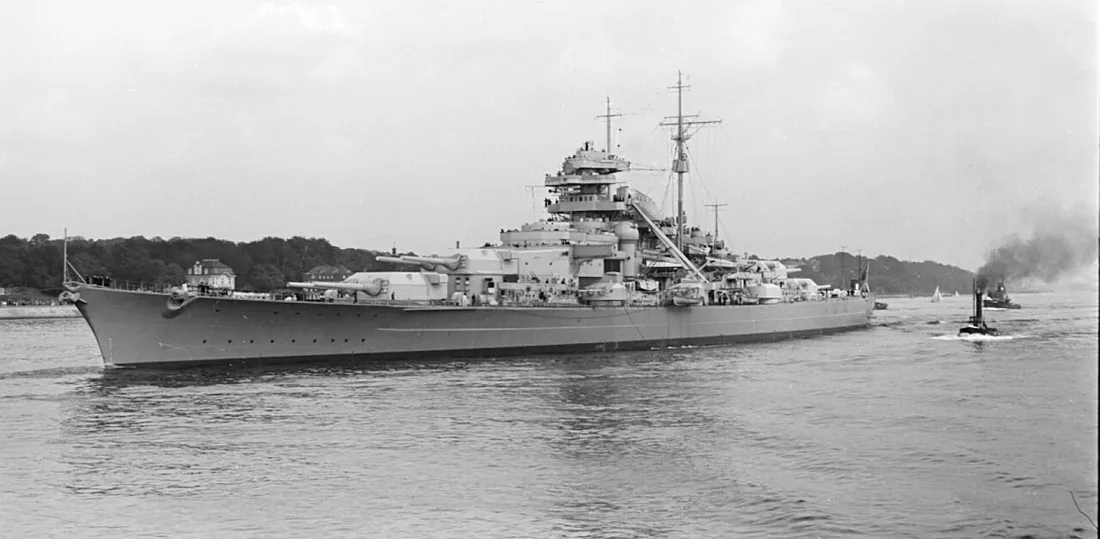
On her first operation Bismarck sank the British battlecruiser Hood with almost all her crew. Three days later the Royal Navy caught her. This is the deepest wreck in the atlas.
Cause. A torpedo jammed her rudder; British battleships wrecked her guns, cruisers torpedoed her and her own crew set scuttling charges. How much each contributed is still debated.
Plate · elevation, starboard side
The ship
Load waterline
Elevation, starboard side
The last hours
Ship drawn to scale; the water below is not.
-
24 May 1941
Denmark Strait
Bismarck and the cruiser Prinz Eugen sank HMS Hood. Bismarck was hit too, began leaking fuel, and turned for France.
-
26 May, evening
The rudder jams
Swordfish torpedo bombers from the carrier Ark Royal attacked; one torpedo struck the stern and jammed her rudders. She could no longer steer away.
-
26–27 May, night
Destroyers circle
British and Polish destroyers shadowed and attacked her through the night as she steamed in circles.
-
27 May, 08:47
The final battle
The battleships Rodney and King George V opened fire; Bismarck replied a few minutes later.
-
About 09:30
Guns silent
With all her main turrets out of action, her executive officer ordered the ship scuttled and abandoned.
-
About 10:20–10:40
She capsizes
The cruiser Dorsetshire fired torpedoes and the scuttling charges went off. She rolled over and sank by about 10:40.
-
About 11:40
The rescue cut short
Dorsetshire and the destroyer Maori were pulling men from the water when a U-boat was reported, and they left. Of about 2,200 aboard, 114 survived.
Below about 200 m almost all sunlight is gone. This is where the twilight zone begins.
Below 1,000 m no sunlight reaches at all: the midnight zone. The only light is made by living things.
The abyss. The water here is a degree or two above freezing all year round.
At 4,700–4,800 m the pressure is about 480 times what it is at the surface.
- Empty barbettes: the turrets fell out
- Tower mast and funnel gone
- Stern broken away, never found
Elevation, starboard side, as found.M volcanic slope and mud · about 4,700–4,800 m
As found
Where she lies
Her hull rests upright, having slid about 2 km downhill after hitting the bottom. All four main turrets fell out as she capsized and lie nearby; her stern broke away and has not been found. Later surveys saw few holes in her main armour belt, which feeds the old argument over gunfire against scuttling.
Found
Found on 8 June 1989 by Robert Ballard's expedition, with deep-towed sonar and cameras, on the slope of an extinct seamount.
Today
A war grave. The position is kept confidential by its discoverers; the mark here is approximate.