No. 06 · Olympic-class ocean liner
RMS Titanic
Lost 15 April 1912 · North Atlantic · about 3,800 m
The largest ship afloat when she sailed in 1912, Titanic sank on her maiden voyage after striking an iceberg, with the loss of about 1,500 lives.
- Flag
- United Kingdom (White Star Line)
- Built
- Harland & Wolff, Belfast, 1909–1912
- Length
- about 269 m
- Aboard
- about 2,200
- Lives lost
- about 1,500 (counts range 1,490–1,517)
- Survived
- about 705–712
- Position
- 41°43.5′ N, 49°56.8′ W
- Lies at
- about 3,800 m, mud
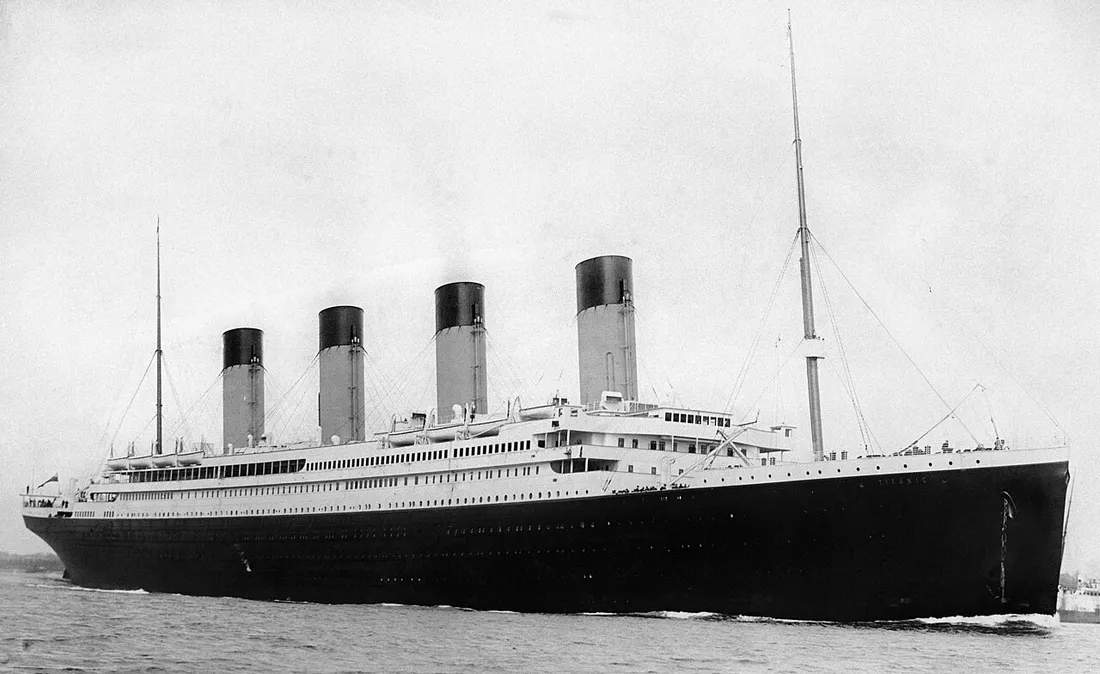
Four days out from Southampton on her maiden voyage to New York, Titanic was crossing a calm, moonless sea at speed. She carried lifeboat places for about half the people aboard, which met the regulations of the day.
Cause. She struck an iceberg, which opened at least five of her forward watertight compartments, and sank about two hours and forty minutes later.
Plate · elevation, starboard side
The ship
Load waterline
Elevation, starboard side
The last hours
Ship drawn to scale; the water below is not.
-
14 April 1912, 23:39
Iceberg, right ahead
Lookout Frederick Fleet saw an iceberg directly ahead and telephoned the bridge. First Officer William Murdoch ordered the ship turned.
-
23:40
The collision
The iceberg scraped along her starboard side below the waterline and opened the forward compartments to the sea.
-
15 April, about 00:05
Boats uncovered
After her designer Thomas Andrews reported that she would sink, Captain Edward Smith ordered the boats prepared and distress calls sent.
-
00:45
The first boat
Lifeboat No. 7 left with about 28 people in it, far below its capacity. Distress rockets were fired over the next hour.
-
02:05
The last boat
Collapsible D was the last boat lowered from the davits. There was room in the boats for only about half of those aboard.
-
02:20
She goes down
The ship broke apart and sank. Most of those still aboard died in the freezing water.
-
About 04:00
Carpathia
The Cunard liner Carpathia arrived at about four in the morning and over the next hours took aboard everyone in the boats, about 710 people.
Below about 200 m almost all sunlight is gone. This is where the twilight zone begins.
Below 1,000 m no sunlight reaches at all: the midnight zone. The only light is made by living things.
At 3,800 m the pressure is about 381 times what it is at the surface.
- Empty davits
- Where funnel no. 1 stood
- Foremast, fallen across the bridge
- Forefoot buried in mud
- Torn away here
Elevation, starboard side, as found.M mud · about 3,800 m
As found
Where she lies
She lies upright in two main pieces about 600 m apart. The bow is fairly intact; the stern is badly collapsed. Iron-eating bacteria grow over the steel as 'rusticles', and parts of the decks have fallen in since 1985.
Found
Found on 1 September 1985 by a French–American expedition led by Jean-Louis Michel of IFREMER and Robert Ballard of Woods Hole. Their towed camera sled Argo saw debris, then a boiler, and followed the trail to the hull.
Today
A memorial site, protected under the 2001 UNESCO Convention on underwater cultural heritage since 2012 and by an agreement between the UK and the US.